

The Water Pressure Problem in Your Leadership
Why time and experience don’t automatically update the mental models running your decisions.

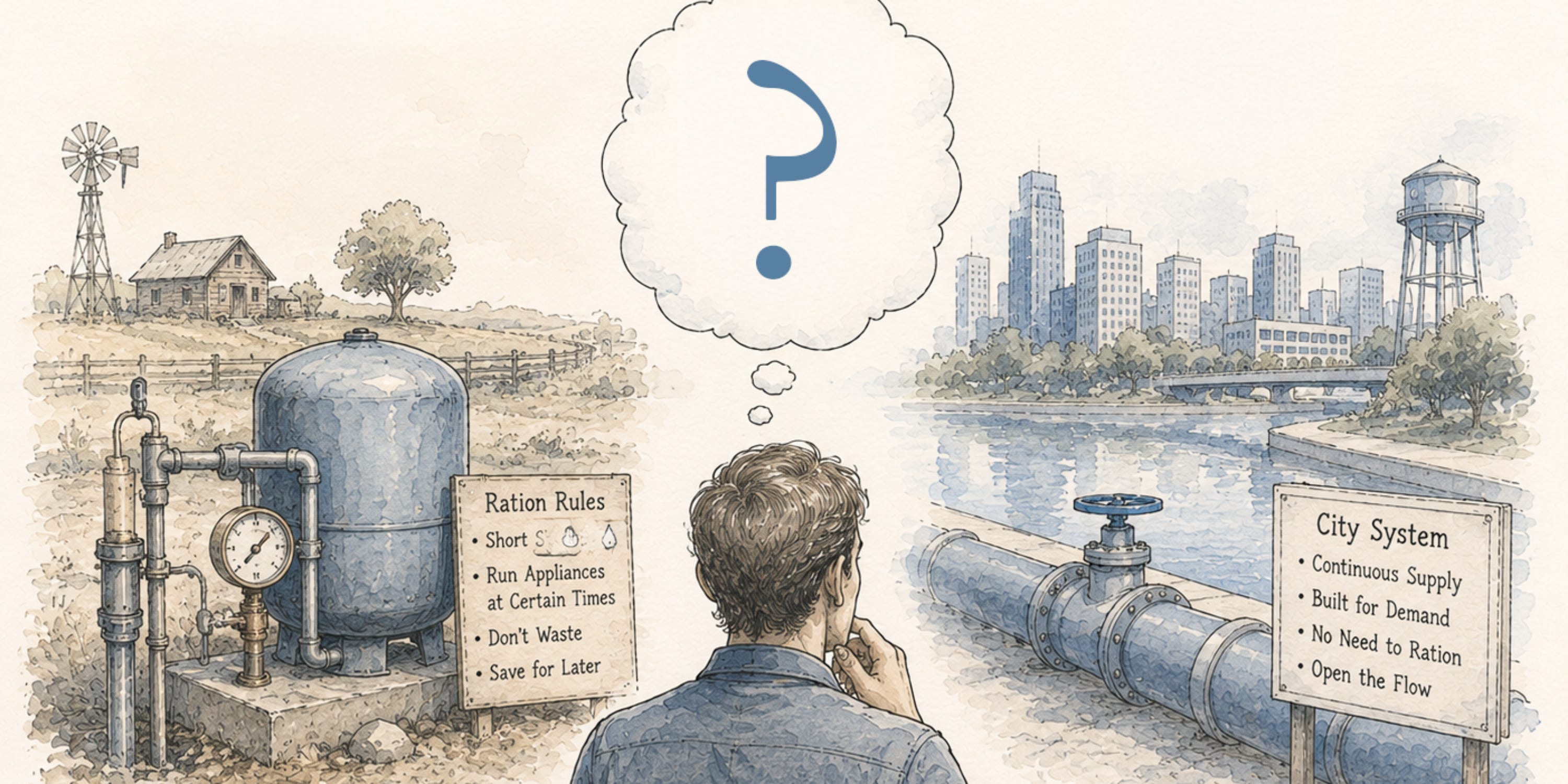
Right before I hopped in the shower, my wife hollered an update from the other room. I need to water the plants outside; let me know when you’re done. Then I need to run the washer and dishwasher, but I can’t do that until you’re out of the shower and I’m done watering.
Puzzled, I agreed, not yet knowing exactly what impact this information had on my shower plan. I proceeded into the Best Place to Think™ and replayed the exchange we just had. I certainly don’t care how or when the plants are watered or when the washers run. Furthermore, our water supply is just fine.
Wait. That’s it. I pieced it together.
She grew up in the dry, rural Midwest with a private well. Private wells operate at low pressure and require a pressure tank to increase the water pressure to a usable level. The tank pressure fluctuates between the cut-in and cut-out points, the pressures at which the air compressor starts or stops to pressurize the tank. As faucets, fish tanks, ice makers, sprinklers, hot tubs, pools, and showers draw from the water system, the pressure in the tank is depleted down to the cut-in point and the pressurization process starts all over again. This takes time, so water pressure varies wildly within the pressure range. When combined with the time it takes a water heater to heat, the timing of water activities around the needed temperature and pressure becomes an exercise in dynamic prioritization and coordination, often with multiple people needing the water system at once. That was her default context for water consumption.
Here’s the thing: we’ve been married for fifteen years, living in a metropolitan area where the water system operates at a significantly higher pressure, requires no repressurization time in the house, and is always there when we need it. It’s an engineering marvel we mostly take for granted.
In other words, she was still running a rural pressure tank mental model in a city water grid reality. In fact, she didn’t see how deeply that mental model was ingrained into everyday life until she proofread this draft.
Leadership researchers see the same thing in organizations, teams, and boardrooms: CEOs who never examine or update their mental models struggle to lead planned transformational change effectively. They’re still running a “well and tank” model in a municipal system.
Here’s why this illustration matters for leaders, organizations, and teams:
Time and experience don’t automatically update the mental models that are holding you back from your best leadership.
In the water example, Sarah’s mental model classifies water, pressure, and temperature as scarce, and thus, she sequences tasks to fit within those constraints. In the country, that’s important. In the city, those constraints don’t exist and the same workflow requires more effort and energy to manage. In fact, our water heater capacity is the only real constraint we have, but during an extended power outage, we learned that we have about two days of hot water before being forced into the world of cold plunges. Aside from overall water conservation and wise usage, the activities and sequencing of the rural model don’t actually serve us in the city.
When the context changes, enablers in the past become constraints in the present and future.
Impact on Organizations
The same hidden logic that governs our showers governs our strategic decisions. Organizational change research supports that: leaders’ mental models determine what they notice, how they interpret it, and which options they see as available. If you don’t question those models, you limit your choices after the constraints change or disappear.
I think of the leaders who are taking on new projects, roles, or teams, or leading through the rapidly changing business, technology, and economic environment. Time and experience are highly valued by hiring managers and are used to justify a company’s decisions. Years in the role and years in the industry look impressive on a résumé and insightful on presentations. There’s one problem: the research doesn’t agree.
Chad Van Iddekinge and his colleagues reviewed more than 80 workplace studies spanning 60 years to see whether prior work experience predicts how someone will perform in a new job. It doesn’t. Across thousands of people, the correlation between pre-hire experience and job performance was weak; in many cases, there was almost no relationship at all. Another meta-analysis of prior work experience came to the same conclusion: “experience required” is one of the worst predictors of job success, even when the previous role looks similar on paper.
Track record is not a true indicator of future performance.
Track record is a truer indicator of how much we want to feel safe.
In fact, a track record is more effective at allaying your fears and insecurities as a hiring manager than it is an indicator of a candidate’s future success. We pretend we’re screening for capability and best fit, but mostly we’re screening for comfort. That doesn’t make you a bad leader. It makes you human, and it gives you a chance to lead differently.
This aligns with much of the deep work I do with leaders. Our own underlying mindsets and beliefs show up in nearly every aspect of our lives including the way we engage in business, make decisions, and lead. If you are unaware of the factors driving your life, you’ll lose effectiveness because you’ll drift toward decisions that support your unconscious needs. For example, I’m sure you have experienced the corporate cascade of pressure: a CEO mentions something in passing; the assistant relays it as urgent; the manager responds as if it’s an emergency; and the engineer scraps all other assignments to deliver that one request immediately, only to find out the CEO doesn’t need that report until next month. Because of the underlying need to be liked, feel safe, or to be seen as effective, everyone’s response was not actually about the request at hand; it was about their unconscious needs being met first. The negative impact of operating that way can be avoided if those unconscious needs are known.
At the executive level, outdated mental models show up as failed transformations, misaligned restructures, and “safe” hires who are only capable of replicating old playbooks. Boards and executive teams often double down on track record and tenure in moments of uncertainty, exactly when the research suggests they should be looking at learning agility and judgment instead. (Reminds me of the
Organizational change research calls this out too: when leaders don’t examine the mental models underneath their actions, they adopt strategies that feel familiar but fail to fit the new context. That’s what happens when we hire for “experience” in an environment that demands adaptability, self-awareness, and learning agility. Or when we run the “CEO requests supersede all other work” model that may have been developed in previous roles.
In contrast, if you lead and hire from a meta performance mindset, you will look for and unlock potential in your teams. You need to hire and lead for things that haven’t been accomplished yet and for things that don’t show up on a résumé. The meta-analysis on hiring suggests better predictors are things like cognitive ability, job knowledge, and work samples, signals of how people think and learn in new environments, not just where they’ve been.
For instance, SpaceX didn’t hire engineers who have built reusable boosters before. They created an environment where engineers could explore unknown territory and accomplish what was previously impossible. They hired for identity-level ability — problem solving, extreme curiosity, and a willingness to rethink constraints and work from first principles — not for “years of experience building rockets with reusable boosters.” That’s what meta performing leadership is about.
Question: Which constraint is your enterprise strategy still obeying that no longer exists?
Impact on Leaders
Leaders who have earned their seat with expertise face the risk of their previous mental models becoming so ingrained that they lose their metacognitive ability, sure that their expertise is their strongest asset. But when the context or external factors change, that’s the point where leaders feel uncertainty, stress, and burnout. If your brain’s main story is “I’m valuable because I know the right answers,” then every environmental variable feels like an indictment, not an invitation into curiosity.
The trend data should make this impossible to ignore: burnout is climbing. In one cross-dataset analysis of business and workplace trends, “burn-out” showed roughly 201,000 monthly searches with strong growth and negative sentiment, and that’s before you add related terms like “occupational burnout” and “mental exhaustion.” Leaders are not just burned out; they’re searching for answers late at night or on weekends.
But they’re often searching for what burnout feels like: decision fatigue, time anxiety, time famine, morning anxiety, cortisol detox. These aren’t just phrases from modern marketing keywords. They’re the actual terms leaders use to describe their days. Decision fatigue and time anxiety, in particular, are showing sharp growth and volume.
At the same time, leaders are desperately trying to fix all of this with new gear. Compression boots. Portable saunas and cold plunge tubs. Red-light therapy. Breathing devices. Journaling kits. Gut health and cortisol detox supplements. There’s a huge economic boom in recovery, nervous-system-regulation, and overall wellness products. Many leaders are trying to buy themselves a spa day for the symptoms, leaving the underlying mental models completely untouched.
Leaders who have earned their seat through expertise alone are at the highest risk of this pattern. The more your identity is built on “I can carry more,” the more likely you are to respond to decision fatigue with more decisions, time famine with more hours, and burnout with more personal grit. Leaders who openly examine and challenge their thinking have more options and choose more effective strategies during change. Those who don’t get trapped in misalignment, ineffective personal or organizational transformation, stress, and frustration.
Time spent in a new leadership seat doesn’t equate to identifying which mindsets are holding you back. In effect, in a new leadership seat or context, the demands on your “water system” increase, but your pressure tank mental model stays the same.
At some point, every leader hits the hot-water or pressure limit of your mind. You can keep running the rural pressure tank system, or you can acknowledge where you actually sit and serve now.
The good news is that the research is kind to leaders who are willing to step outside their own thinking. Studies of effective leaders find that metacognitive skills — questioning your own assumptions, analyzing your mental models, and comparing what you say you believe to what you actually do — open up more choices and better strategies. Metacognitive leaders build organizations that can update their collective mental models faster than the market changes. Leaders who don’t do that spend more time arguing with reality and less time making progress.
The first moment of radical awareness is the shower moment where you realize Hold on. The constraint I’m organizing my leadership around doesn’t exist anymore.
Then, radical honesty is admitting what that constraint has been providing for you: safety, certainty, identity, the feeling of being needed, etc.
Exercising radical agency is what you do next, the deliberate choice to adopt new mental models that fit your current reality, and a new way of hiring, leading, and living that doesn’t require you to be exhausted to feel valuable or effective.
Executive Reflection
What constraint are you still organizing around that no longer exists?
Identify a hiring decision or promotion where track record drove the choice; what comfort need did that serve and how has it worked out?
Are you willing to upgrade your pressure tank model into something new?
If you’re noticing pressure‑tank patterns in your own leadership or your team, this is the work we can explore together.
Let’s talk about which water pressure system you’re operating →
* * *
Aaron Ott is an executive coach who helps leaders promoted for expertise become the leader the role actually requires. He spent 19 years navigating the expert-to-leader transition in the non-profit and for-profit spaces. His coaching practice is built on one belief: your identity can grow as fast as your role, if you’re willing to look at the mental models underneath it. He lives in Omaha, Nebraska with his wife, Sarah, who is a non-profit operations leader, author, and writing coach. This article is 100% human created. AI-created content variants may help publicize this piece.
For Further Reading
On mental models and organizational change
Lesley University dissertation: The Role and Impact of Leaders’ Mental Models in Effecting Planned Transformational Change – How CEOs’ unexamined mental models shape the success or failure of major change efforts.
Link: https://digitalcommons.lesley.edu/education_dissertations/95/
TFZR paper: Mental Models for Leadership Effectiveness – Explores how flexible, explicit mental models correlate with more effective leadership in complex environments.
Link: https://scindeks-clanci.ceon.rs/data/pdf/2334-9638/2012/2334-96381202057M.pdf
Springer chapter: Leading Organisations in Turbulent Times: Towards a Different Mental Model – Argues that agility requires leaders to adopt new cognitive frames that emphasize experimentation and systems thinking.
Link: https://link.springer.com/chapter/10.1007/978-3-319-98884-9_4
Walden University dissertation: The Effect of Mental Models on Creating Organizational Alignment Around a Change Vision – A case study of how misaligned mental models distort change communication and outcomes.
IHRIM article: May the Force Be With You: Using Mental Models to Change Company Culture – A practical look at how shared stories and mental models create the “force field” of culture.
On experience, hiring, and future performance
HBR article: Experience Doesn’t Predict a New Hire’s Success – Summary of a large meta-analysis showing that pre-hire experience is a poor predictor of job performance and retention.
Link: https://hbr.org/2019/09/experience-doesnt-predict-a-new-hires-success
Florida State University / Clemson coverage: Work Experience Poor Predictor of Future Job Performance – News write-up of the same research, highlighting implications for common “experience required” practices.
Links:
https://wertheim.fsu.edu/article/work-experience-poor-predictor-future-job-performance
https://news.clemson.edu/clemson-study-challenges-job-experience-in-hiring-decisions/
LSE blog: Previous Work Experience Is Not a Good Predictor of How People Will Perform in a New Job – Accessible overview of why prior employment says little about future effectiveness.
ScienceForWork article: Recruitment: Is an Experienced Hire a Better Hire? – Evidence-based summary of how experience compares to other predictors like cognitive ability and work samples.
Link: https://scienceforwork.com/blog/recruitment-hiring-for-experience/
LinkedIn summary of meta-analysis: Experience ≠ Performance – Brief breakdown of the effect sizes for experience vs. other selection methods.
On cognitive models, change leadership, and mental models in practice
Coaching Federation report: The Cognitive Models of Change Leaders – Describes the mental frameworks effective change leaders use (e.g., first principles thinking, second-order thinking).
Link: https://researchportal.coachingfederation.org/Document/Pdf/2019.pdf
Forbes article: 5 Time-Tested Mental Models To Help You Become A Better Change Leader – A practical tour of mental models relevant to leading change.
ScienceDirect article: Cognitive Shifts Within Leader and Follower Teams: Where Consensus Develops in Mental Models During an Organizational Crisis – Examines how shared mental models evolve in crisis situations.
Link: https://www.sciencedirect.com/science/article/pii/S104898431630234X