

The Expert in You Is Sabotaging the Leader You're Becoming
The skills that built your reputation are the ones quietly costing you the role.

What is your superpower? What’s something that’s easy for you that not everyone can do? What’s the thing people always want to pick your brain for (usually badly disguised as a coffee invitation)?
Now take a moment and celebrate that thing. Celebrate everything that makes you you. Folks around you look to you as the expert in something. You may even have awards and certifications that prove your expertise to the world and substantiate the seat you’re in. Your 10, 15, or 20 years of experience earned it and you have every right to be proud.
So, why are there still times when it feels like you’re drowning in the very role your talent was supposed to prepare you for? As you count the egg rolls in your Friday night take-out order on your way home, why is it that you’re also counting down the days to your next vacation?
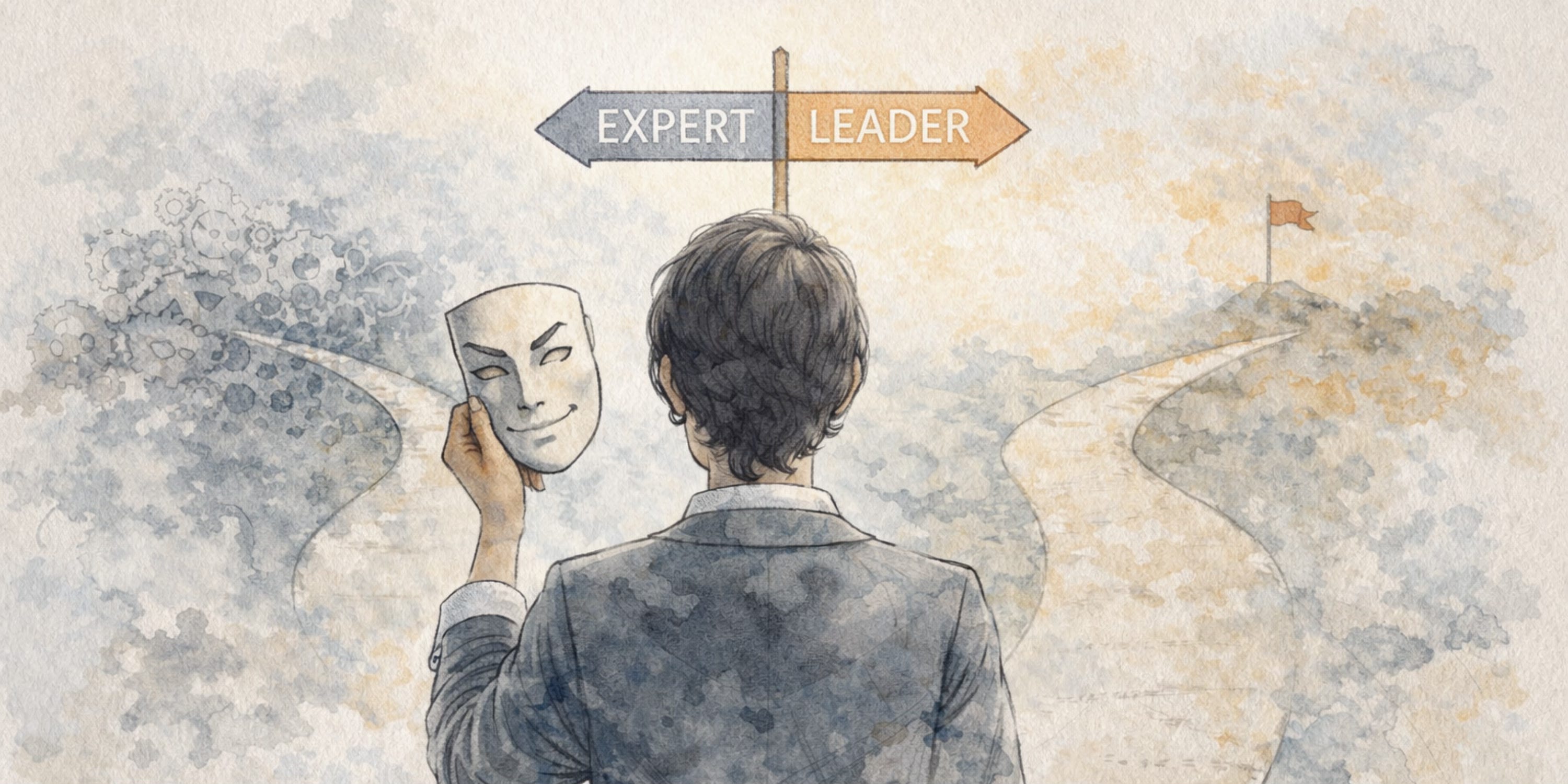
Here’s the truth: the skill set that made you exceptional as an expert is the same skill set that’s exhausting you as a leader.
I lived this lackluster limbo before I could fully see it, name it, and do something about it. I kept running the same play that had always worked for me: see a gap, own the solution, deliver at a level nobody could question. It worked time and time again. Until it didn’t.
I remember the first time I noticed resentment creeping in, not toward the job, but toward myself for letting expertise become my whole identity. I knew my internal operating system was breaking when the things that previously brought fulfillment now brought frustration instead. Those feelings didn’t mean I lacked skills and ability, but it meant that I was shifting from do the thing to lead the people who do the thing, which is a completely different ability. Nobody teaches you that in Expert School. I kept doubling down on my old approach, convinced that working harder was the answer, setting an implicit example for others to follow, and then hoping others would be inspired to rise to the occasion around me.
News flash! That wasn’t the answer. I had to stop doing long enough to notice that I was solving the wrong problem.
If you’re like most people, you might resonate with this picture:
You get promoted or land a new seat, and the first six months are chaos, exciting chaos. You’re learning, building, and earning trust. Most importantly, your boss is happy because you’re delivering.
Then, slowly, something shifts. You start doing more and leading less. You’re involved in every project, reviewing every deliverable. You’re answering Slack messages that your team should be handling in the interest of maintaining timely communication. You’re staying an extra hour or two because “it’s just easier if I do it.” You tell yourself you’re being a good leader, setting the standard, protecting quality, and having your team’s back.
But what you’re really doing is recreating the expert role inside a leadership title.
Why? Because the expert role feels safe and familiar. You already know how to succeed and win there. The leadership role — the one that asks you to trust other people’s work, tolerate imperfection, sit in strategic ambiguity, and influence without controlling — feels like walking blindfolded into Parisian roundabout traffic. So you default back to doing.
The thing that got you here becomes the thing that keeps you stuck.
This pattern has catastrophic consequences for you and for everyone under your leadership.
When you hold work too close, your team stops growing. They learn that you’ll always catch it, fix it, or redo it. So they stop stretching themselves or even trying. The best ones start burning out or leaving because they’re on your team to lead, not to be micro-managed.
When you over-function like this, you become the bottleneck. When every decision, approval, or judgment call runs through you, your team and the organization start to believe that’s how it has to work because you’ve trained them to depend on you.
And personally, when you collapse your value into your output, you burn out. The slow, grinding kind of burnout where you wake up after a Sunday afternoon nap with a knot in your stomach and think, I can’t keep doing this, but you do it anyway — because you don’t know who you are if you’re not the one delivering, and you’re nothing if not a person of your word.
This is where many leaders get stuck. It’s not because they lack talent, skill, or ability, it’s because they use too much of the wrong kind of talent for the role they’re in now. It’s hard to let go of it because letting go feels a bit like dying or letting yourself down.
Against our natural wiring, here’s what this moment requires:
You have to be radically honest with reality. This isn’t about what should be happening or what you wish were true. You need to be radically honest with what is actually, observably, happening right now. In her book Loving What Is, Byron Katie states that “The only time we suffer is when we believe a thought that argues with what is.” When I first read this quote, I let the book drop into my lap, stared into the middle distance, and replayed a mental reel of all the situations where I was arguing with what is. All my stress was wrapped up in thoughts like: “My team should step up…” “They should ask more questions…” “It doesn’t feel like So-And-So gets it…”
Yep. My team didn’t step up. They didn’t ask more questions. So-And-So doesn’t get it.
Until you stop arguing with that reality, nothing is going to change. Once you acknowledge what is, you get to choose how to move forward.
In that moment of honesty, I felt my agency return.
If you do this work, you might honestly see that you’re over-functioning, not delegating, not trusting your team. By refusing to acknowledge this reality, you’re continuing to reinforce your identity on being the doer. But now, the role needs you to be the leader. Your team needs you to create strategic pathways for their growth. Your stakeholders need clear communication. No amount of time management tips, delegation frameworks, or leadership books will fix this for you because the issue isn’t behavioral. It’s identity.
The question underneath the surface symptoms is this: Who am I if I’m not the one doing the work?
How does that question land for you? Does it ring truer than you’d like? Does it hurt? It’s not a question you can answer with a strategy. It’s a question that requires you to sit with the uncomfortable, hard facts about what is. It invites you to examine what’s been driving you. Not just what you’ve been doing, but why you can’t stop doing it. It challenges you to look at the hidden driver underneath your hustle and ask whether it’s serving you or consuming you.
The expertise that got you here is real. Your years of effort, mastery, and reputation are yours to celebrate. You earned them. But now, your identity needs to expand beyond your expertise.
Let me say it again: the thing that got you here becomes the thing that keeps you stuck. What got you here is external. What gets you there is internal. The next chapter of your leadership requires a different version of you, one who can lead without producing. One who can trust without controlling. One who measures their value not by what they deliver, but by what they develop in others.
This transition feels disorienting. It means you’re growing past the identity that’s been running your life and leadership.
The leaders I work with often arrive at the same realization: the stuckness they felt wasn’t a sign that they were failing. It was a sign that they’d outgrown their previous strategy. Once a leader really sees it, things begin to shift — not because they worked harder, but because they stopped arguing with reality about who they needed to become.
If you have always been the expert and you’re starting to wonder if there’s a ceiling above you that no amount of effort can break through, the hard truth is: yes, there is a ceiling and performance alone won’t break it.
It’s an identity issue that can only be solved through identity expansion.
This is exactly the transition I coach leaders through. You don’t have to figure it out alone.
Aaron Ott is an executive coach who helps leaders promoted for expertise become the leader the role actually requires. He spent 19 years navigating the expert-to-leader transition in the non-profit and for-profit spaces. His coaching practice is built on one belief: you’re not stuck and you’re not a fraud — you’re in the most important career transition nobody prepared you for. He lives in Omaha, Nebraska with his wife, Sarah, who is a non-profit operations leader, author, and writing coach. All emdashes are chosen to serve a purpose.