

Row, Row, Row Your Boat
Three leadership lessons from a woman rowing solo across the Pacific ocean.

I’m endlessly inspired by the question “What am I capable of?” and the people who respond to the question by pushing the boundaries of what’s possible. Exploring that question is why I launched this newsletter and why I continually advocate for people to explore untapped potential. I believe effective leadership, then, requires leaders who continually raise the ceiling and redefine the floor, creating new contexts in which people can expand and fill their potential.
You do not exist to survive. You do not exist solely for staying comfortable and unchallenged, or even to extract as much value as you can out of your industry and demonstrate it on your bottom line. I believe that you and I exist to create value by exploring untapped potential, and that this is what it means to be human.
This week, I want to tell you about someone who is answering this question in a uniquely challenging way.
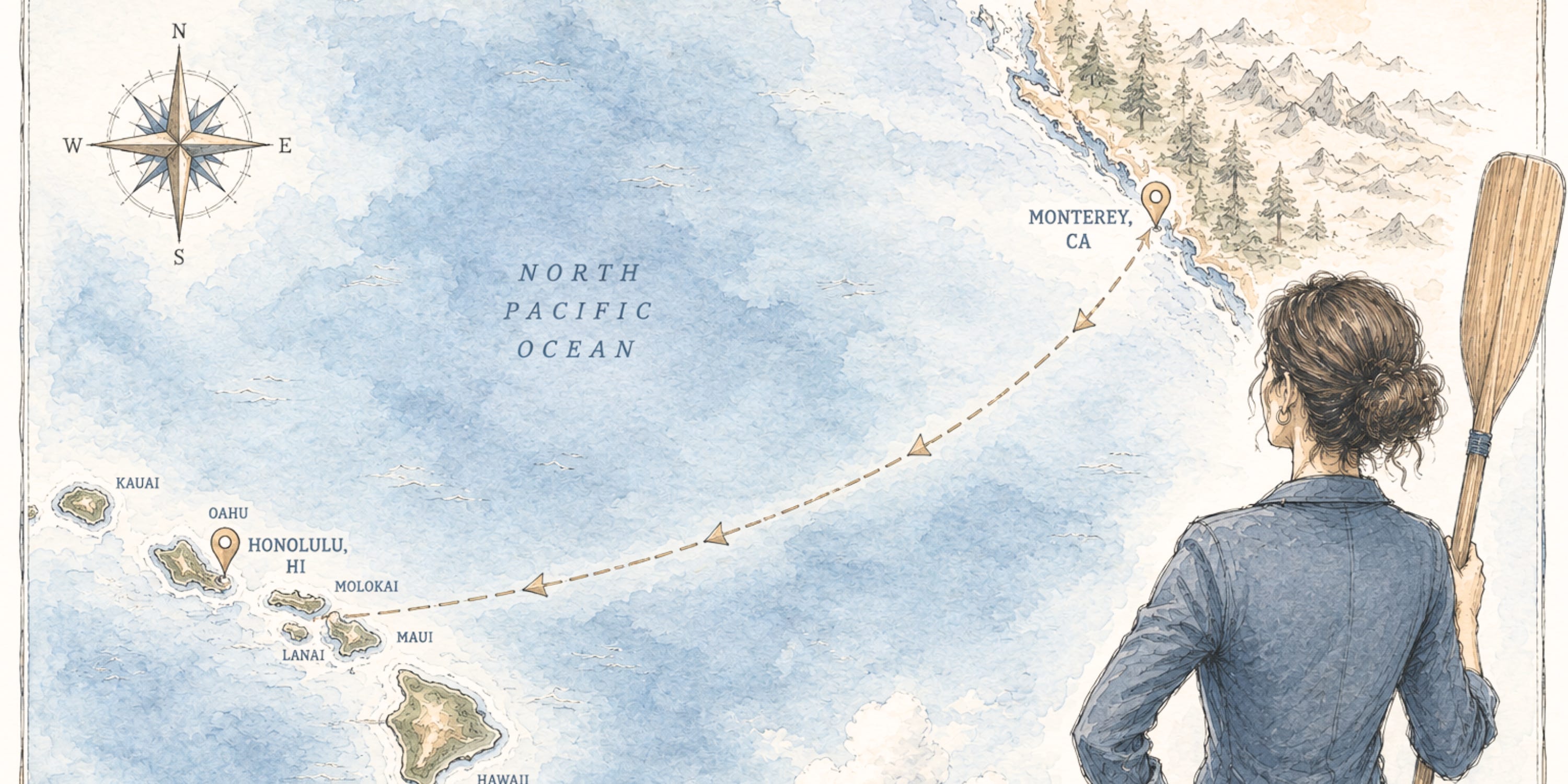
At the time I’m writing this, 31-year-old Kelsey Pfendler is in the process of becoming the first American woman to solo row from California to Hawaii. She’s posting live updates on social media and tracking her progress on her website. Her journey has captured me the same way the Artemis II mission did, and I check her progress map every morning to celebrate every mile accomplished.
This kind of journey would seem impossible to most of us. For her, it’s the next logical thing. She crossed the Atlantic by sail in 2020. And then in 2024, she led the four-woman team, Hericane Rowing, on a successful team row across the Mid Pacific. Now, she’s attempting to solo row the Mid Pacific route.
The leadership principles in her story are endless, but let’s look at a few that stood out to me the most.
Have You Met Your Cool Friend?
If asked who you are, you might respond with a job title, brief family overview, and your drink or hobby of choice. It’s the great Professional Introduction Recipe™ served at the networking buffet every Tuesday morning. It works, in a pinch, and it’s entirely based on who you’ve been in the past.
What parts of you haven’t you met yet? Who might be waiting for you at the outer edge of what you’re willing to attempt?
Kelsey described what propelled her to seek this journey solo: “I wanted to do it alone. I wanted to see what I could do by myself and what I could make possible… And I love hard things… There’s a part of my person or a piece of me that I don’t really get to hang out with unless I’m doing really hard things. Because I do think I become someone I know is in there and who I want to be.”
Have you met that version of yourself, the cool friend? Do you enjoy hanging out with them? How often do you get to hang out with that person?
In business, your undiscovered leadership potential is your cool friend. Your vision is where you go to find them. If the vision feels accomplishable, it may simply be a plan and you may be the executor of the plan. If the vision is not requiring you to explore corners of your leadership that you haven’t developed yet, it’s not a vision. As you lean into unknown territory, you will eventually hit resistance. At each of these points, you’ll need to examine what story you’re telling yourself about the resistance, choose how you respond to it, and then decide how to bring your team through the same moment. Your teams are waiting to buy into the vision until they can sense that you believe it; the leader they will follow may still be out there in one of those unknown areas, waiting for you to come and inhabit it.
Know What You Can Control
In another of her recent social media updates, Kelsey describes why she loves the ocean so much while reflecting on a few emerging challenges. “When you’re out there, you’re not in control. I couldn’t change the weather. I couldn’t change the squalls. I couldn’t fix the fact that I slept in. But I know for a fact that when you aren’t in control of what’s happening, you are in control of you.”
There are few things less controllable than the sea. After all, when the sea meets land, the sea always wins. You’ll never hear of a sandbar splitting an ocean in two. Rather, the sea redistributes the sand when and where it pleases. Kelsey understands the supremacy of the sea and, more importantly, she understands the scope of her agency.
In response to how she felt navigating the challenges, she continues: “I wasn’t showing up the way I wanted to with how I was talking to myself and how I was working through the problems that the ocean decided to present to me. The way you respond to problems is so much more important than the problem itself. Now that I’ve stopped holding so tightly to trying to be in control of what was happening, I feel a lot better.”
She’s taking full ownership of every stroke, every navigational decision, and every tool at her disposal that lets her harness the difficulties of the situation to create forward progress. Her journey is not about overcoming the ocean or subduing the weather patterns. It’s about the growth of continually overcoming the way she responds to and interacts with each situation.
The motivational poster version of this is: control what you can control. This is a paraphrase of thoughts from Marcus Aurelius’ Meditations: “You have power over your mind — not outside events. Realise this, and you will find strength.”
Many teams I’ve led exhibit the default human tendency to complain about situations, people, or problems. It’s often a silent cry for help or to be seen or heard. However, the most valuable leadership lessons I’ve learned about what truly transforms teams is that the most powerful way for someone to feel helped, seen, and heard is not to provide answers, fixes, or solutions. It’s to help them see the agency they already have and to create the impact they want to see. Nothing diffuses stress and frustration like owning what you can do about it.
As a leader, you can’t afford to get stuck on what you can’t control either. A team whose leader is stuck on what they can’t control will stop bringing problems to that leader.
Miracle of the Mundane
Finally, in stark contrast to Kelsey’s headline-creating, record-setting vision of becoming the first American woman to row the Mid Pacific is the reality of her everyday schedule.
Near the halfway point, she reflected on struggling with no wind, stalled momentum, and the increased physical effort in maintaining progress through gray, drizzly days. She acknowledged the dreary, wind-less days as simply part of the journey, necessary building blocks for an accomplishment like this.
This is another paradox of leadership for leaders to hold: record-setting achievements rarely emerge from single heroic acts. More often, they are the compound result of consistent, ordinary actions.
James Clear, author of Atomic Habits, tells the story of professional cyclist coach Dave Brailsford’s commitment to “the aggregation of marginal gains,” which is the philosophy of searching for tiny margins of improvement everywhere you can, and then improving them in incremental steps. The compounded benefit is greater than any single improvement could have produced.
Life and leadership must encompass the highs and lows, and everything in between. Healthy leaders hold space for both a powerful vision and the miracle of the mundane. Leaders become ineffective when they focus on one without the other.
Growing into a greater leadership identity requires venturing into unknown territory, meeting or developing new expressions of yourself, embracing the miracle of the mundane, and controlling what you can control: yourself. It’s letting the power of the vision propel you through each step and into transformation.
Eventually, you’ll arrive at a destination — a goal achieved or a vision realized. Will the leader who arrives be more developed, more expansive, and a fuller expression of you? Will the expression of you be invited into the next chapter to hang out with you?
When Kelsey rounds the corner toward Honolulu, she’ll be celebrating the three-ish months she got to hang out with the coolest version of herself. She may still appear solo on the rowing seat, but the version of her who likes doing hard things will be stronger and more capable than before, ready for the next adventure.
What Next?
Two questions to consider this week:
1. What parts of yourself have you not met yet?
For the business leader, the parts of you that you haven’t met yet exist in situations for which your expertise hasn’t prepared you; in hiring younger generations that don’t see things the same way as you; in leading strategically through technology advancement; and in leading the change management required to build the businesses and teams of tomorrow.
You have a choice to double down on who you are and what you know, or to open up and expand into who you could become in the emerging world.
2. What simple next step do you need to take for growth?
What got you here won’t get you there. What’s worked in your leadership before may need to be adapted to the new situations or people you’re leading today.
You have a choice to wait for forced change and adaptation — and at worst, irrelevance — or you can choose growth and embrace the discipline of compounding small improvements.
* * *
Executive coaching can be a guide into the unknown parts of you that you have yet to meet, and it illuminates the best next step in becoming who you want to be.
For Further Reading
Kelsey Pfendler, You Row Kelsey (yourowkelsey.com). Kelsey’s website tracks her progress in real time, including her route map, social updates, and the story behind the row. It’s worth checking if you want to follow the journey as it unfolds.
James Clear, Atomic Habits (Avery, 2018), Chapter 1: “The Surprising Power of Atomic Habits.” Clear tells the full story of Dave Brailsford and British Cycling’s aggregation of marginal gains philosophy. The chapter is also available in condensed form at jamesclear.com/marginal-gains.
Marcus Aurelius, Meditations, trans. Gregory Hays (Modern Library, 2002). The quote used in this article is a widely circulated paraphrase of Aurelius’s recurring argument throughout Books 2, 4, 6, and 8 that the only domain within our control is our own judgment and response. Hays’s translation is the most readable modern edition. The full text is also available at classics.mit.edu.
Aaron Ott is an executive coach who helps leaders promoted for expertise become the leader the role actually requires. He spent 19 years navigating the expert-to-leader transition in the non-profit and for-profit spaces. His coaching practice is built on one belief: you’re capable of so much more than you could ever dream. He lives in Omaha, Nebraska with his wife, Sarah, who is a non-profit operations leader, author, and writing coach. This article is 100% human created. AI-created content variants may help publicize this piece.