

Moving Out of Averageville, USA
How losing touch with fun and joyful experiences limits our ability to lead and communicate with authenticity.

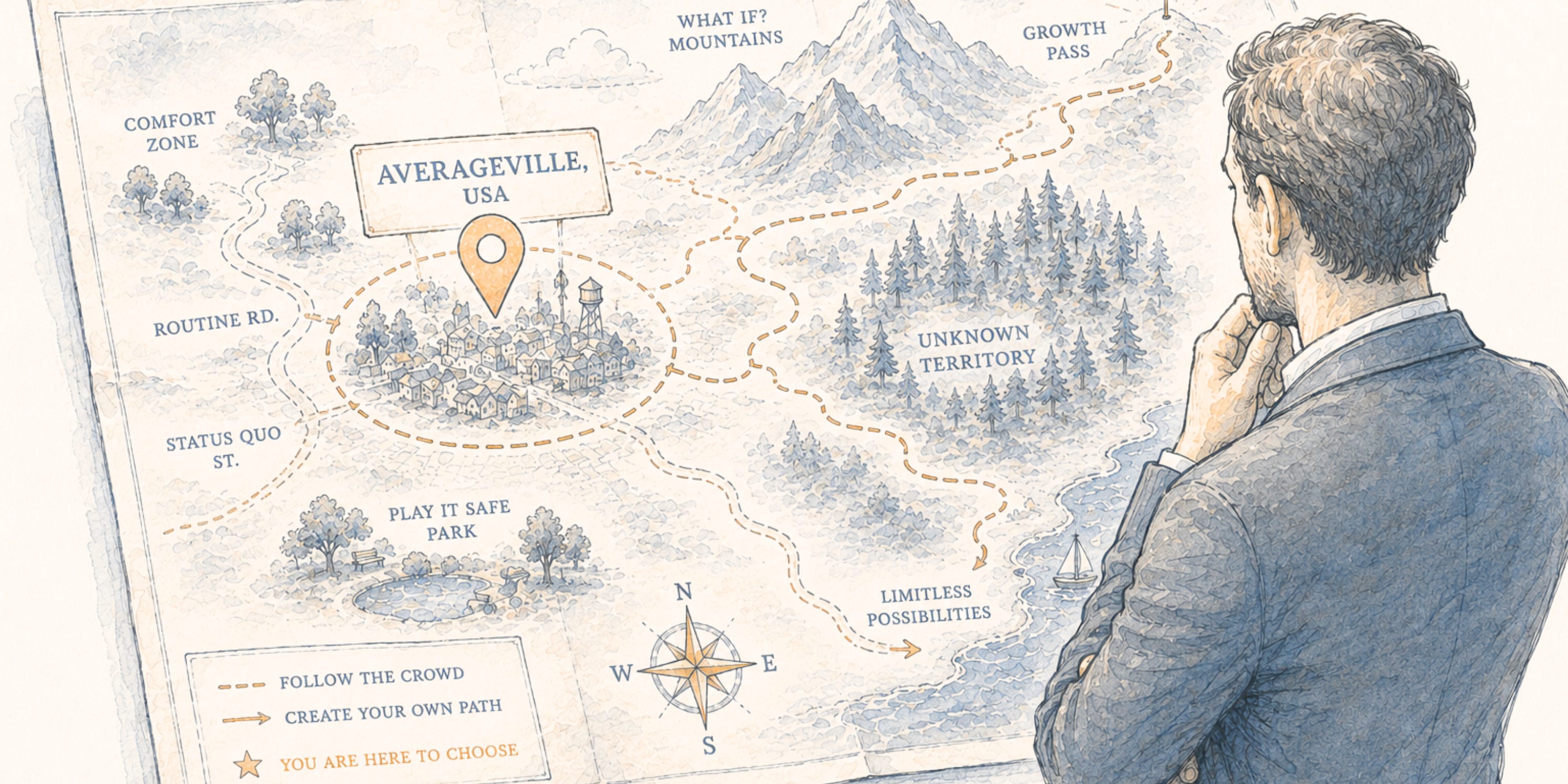
Authenticity is frequently discussed in business and leadership spaces, and often, the message being conveyed is one of balance. Many times the advice amounts to: be personal, but not too personal. Share enough negative or painful parts of a story to balance the positives. Always include how you’ve harnessed pain for growth, but only the kind of discomfort others can relate to. There’s no consensus on what it means to be real and to not be fake.
The result is that many leaders settle into a rhythm of false authenticity in an effort to be authentic. You see this in every meeting segue with ice breaker topics like: “It was a good weekend.” “My kids played sports in the rain.” and “Spent time with the family.” These are all normal and good things, but they’re not necessarily shared insights or experiences that demonstrate true authenticity in a way that builds team trust and connection.
Authenticity requires the courage to feel fully, and the courage to speak from your values.
Averageville, USA
We can all agree that the need for authentic human connection is as true today as it ever has been, though I feel a change in the perceived value of human authenticity as the signal-to-noise ratio degrades in today’s AI-saturated environment. What I mean by that is that since AI is now commonplace, it’s becoming the default tool for leaders to create more content, post more frequently on LinkedIn, and to feel like they’re leading with authenticity. In business contexts, it’s common to employ AI tools to generate project plans, conduct risk assessments, create executive summaries, and draft email updates. It all comes out incredibly bland and balanced — too balanced, even. The near-perfect, comprehensive exploration of all perspectives contains useful information, yes, but it’s devoid of one thing: passion.
It’s as if we’ve all awoken to find ourselves living smack dab in the middle of Averageville, USA.
Though AI is a useful tool, I am concerned that many leaders are losing sense of what authentic connection looks and feels like. I’m finding myself increasingly drawn to human-only work because I want to feel a connection with the creator. I want to feel the inspiration they felt. I want to experience the passion oozing through their creativity. I want my mind expanded through thought exercises inspired by their lines of inquiry. I don’t get the same feeling reading another AI-written article or skimming the emoji-driven status update, regardless of how business-accurate the content is.
Recently, tech journalist Joanna Stern left her traditional roles (The Wall Street Journal, Engadget, The Verge) and launched an independent YouTube channel. One of the things she highlighted in her platform announcement and content guidelines is the value of human creation. “We take pride in human writing, editing, illustration, design, music and more—and we pay real humans for all of those things.” She’s differentiating herself in the 2026 content creator landscape and building a community of like-minded followers. She’s not ignoring AI. In fact, she also has a published content standard for using AI as a workflow assistant and a requirement for working for her company. But she understands where there’s value in retaining human creativity and where there’s opportunity for AI enhancements or productivity.
In your leadership, your colleagues are constantly analyzing your leadership approach to determine whether you’re showing up as a person or a performance.
For leaders, it’s time to move out of Averageville, USA. Averageville is where authenticity goes to die, and the most impactful leaders going forward are the ones who recognize this quickly and act to maintain human connection.
But first, what’s keeping you there?
Emotional Authenticity
Somewhere along our maturity path, we learn to even out the peaks and valleys of this experience we call life. We consider it growth and maturity. We think we’re being ‘realistic’ with our wisdom and discernment when we’re actually distancing ourselves from fun, joy, and connection.
When was the last time you let yourself get fully immersed in something simply for the fun of it or intentionally prioritized a fun thing over a useful one? I’m not talking about the quarterly personal retreat, or the family vacation, or the monthly movie night.
No, I’m talking about the mad dash to your favorite ice cream shop in the middle of dinner because they just announced on Instagram two minutes ago that they have a new batch of a limited flavor for the evening; or the 90-minute drive at 10:30 PM to escape the urban skyglow and potentially see the aurora borealis in Nebraska because a geomagnetic storm just exceeded the Kp index required to see them at our latitude; or the impulse purchase of a $25 ticket and flight to New York City that granted you exclusive access to a private rooftop concert and soirée with some of the world’s leading TV and film composers and musicians.

I’m convinced those experiences stand out to me as just a few of the things that have sparked joy in our lives because they all had an element of unplanned passion. We couldn’t see them coming with enough time to plan for them. We didn’t analyze the potential risks or benefits before making a decision. They were, truly, spontaneous moments that have turned into highly memorable experiences and ignited other passions in our life.
In The Power of Fun, Catherine Price explores what it takes to have True Fun. When playfulness, connection, and flow occur together, you’ll experience True Fun, she says, which is good and necessary for your health and happiness. I’m convinced that somewhere along our professional paths, we’ve lost the ability to engage in fun and are missing out on the ways it enhances our lives and leadership. The Power of Fun reframes what many leaders have lost: the ability to freely engage in fun.
Similarly, in her podcast The Curiosity Shop with Adam Grant, Brené Brown says “Joy is incredibly vulnerable. It’s just in moments of joy, if we’re not practiced in [it], the people who can lean into joy, we found, had one thing in common. And that’s a very strong gratitude practice, that where they’re in joy, they can say ‘I’m really grateful for this moment.’” I want you to see what she identified: that allowing yourself to truly experience joy is an exercise in incredible vulnerability.
My first takeaway is that authenticity requires the vulnerability to fully experience the peaks and valleys of your life.
Brené Brown continues: “One of the things we found in our research is that some people choose to never get too high of an emotion or too low. And the reason why they don’t get too high an emotion is they don’t want to feel disappointment. So they choose to live disappointed rather than feel disappointed.”
This is what I described earlier as living in Averageville. In high-performers and leadership-oriented people, this tends to be a survival pattern that becomes permanent. The leaders I work with often didn’t consciously choose this neutral way of being. They may have been burned once — or a dozen times — by optimism that ended in disappointment or pain. At some point, they decided it was smarter to minimize their feelings to create a safer or more predictable existence.
Here’s a photo of thirteen-year-old me, completely enraptured with joy and excitement with my birthday gift: my very first digital keyboard. I remember the moment and the feeling that I couldn’t physically contain the amount of joy I was feeling. Now, over 25 years later, my reactions are calibrated differently. But I have to ask myself: do I still let myself experience that level of enthusiasm and joy that I once embodied, or have I slid into Averageville for the sake of public image?

When you lead from this constrained posture, you might struggle to generate motivation because you’ve lost the ability to feel enthusiasm. It becomes difficult to inspire or galvanize a team around a vision when you won’t let yourself emotionally invest in or commit to it. You can’t celebrate a big win with people who gave their best because you’ve already mentally discounted the win against everything that could still go wrong in the future.
True authenticity in leadership doesn’t level the peaks and fill the valleys to fit in with the average expected experience. True authenticity doesn’t hide behind the mask of professionalism. True authenticity creates space for the full spectrum of feelings each of our experiences contain.
Here’s what I want to encourage leaders: as you evaluate where you might be living in Averageville, USA, remember AI can’t create True Fun for you; AI can’t experience joy with you or participate in gratitude with you. Those things are your responsibility, and as a leader, your job is to steward the best humanity in yourself and your teams.
So take one step toward moving out of Averageville, USA, by learning to integrate joy, gratitude, and fun into your life and giving it space to show up in your sphere of influence. By choosing to embody fun and joy, you demonstrate inimitable emotional authenticity and expand the space around you for others to join you in authenticity.
Communication Authenticity
The second component to authenticity is ensuring that the things you say align with your values. This is the verbal component on top of the emotional layer we just discussed. Many people mistake authenticity for candid oversharing. Their approach to authenticity is often driven from a desire to use their voice and to express every idea or opinion without a strategic filter. Authenticity does involve honesty, but for honesty and candor to be seen as authentic, it must be aligned with your values.
Adam Grant posted on X: “Authenticity is not about expressing every opinion you hold. It’s about ensuring that what you voice reflects what you value.”
For leaders, this shows up in both the things you say and the things you don’t say. When you’re leading from a compressed emotional spectrum, your communication may collapse into the generalized statements that you share during meeting transitions. Or it may show up as excessive positivity or hype. When it comes to the things you say, the people around you can feel empty words and a lack of grounding in passion or values. On the other side, when you withhold feedback because you don’t want to coach someone else through the emotional valley it creates or when you don’t truly open up and share critical insights, they can feel that too.
Think of the last difficult conversation you left having said the professionally correct thing or the safe thing, but knowing that you didn’t say the true thing.
My second takeaway is that you can’t communicate from your values when you’ve obscured your access to your full range of emotional experiences.
True authenticity is a practice that’s always undergoing change. Leaders become trustworthy when they embody the full emotional experience and remain in touch with their values. When you’re in touch with your emotions and your values, you show up and communicate authentically.
Your team will feel it. You will feel it.
You’ll feel…real.
* * *
Reflection Questions
Where in your life or leadership have you chosen to live disappointed rather than risk feeling disappointed?
Where does your voice not fully reflect what you value?
What’s one thing you’ve been calling ‘professional’ that is actually self-protection?
Let’s talk about the authenticity you’re demonstrating right now →
Aaron Ott is an executive coach who helps leaders promoted for expertise become the leader the role actually requires. He spent 19 years navigating the expert-to-leader transition in the non-profit and for-profit spaces. His coaching practice is built on one belief: you’re capable of so much more than you could ever dream. He lives in Omaha, Nebraska with his wife, Sarah, who is a non-profit operations leader, author, and writing coach. This article is 100% human created. AI-created content variants may help publicize this piece.