

Find the Furthest Bathroom
The art of the intentional transition, the furthest bathroom, and being a stickler about lunch.

A commute, for me, has always been one of my favorite parts of the day. Joining the hustle and bustle of everyone who’s heading somewhere with a purpose feeds my extroversion and energizes my day, and I enjoy feeling like I’m part of making the world go round with everyone else. For years, commute time was just scheduled podcast or audiobook time and I didn’t fully realize its contribution to my overall well-being.
Then 2020 killed it. Like everyone, I went from a full office schedule to fully remote in a matter of days and my productivity climbed at first because I could pour uninterrupted hours into my work. What I did not see for several months was the cost of increased focus: extended time working remotely had erased every transitional period I had before. My commute, walk to the lunch room, or the errands on the way home dissolved into continuous workdays that bled into evenings that extended into weekends. I was always working or thinking about work, and the cognitive load increased every week until work, life, and hobbies merged into one neverending to-do list.
That’s what I want to talk about, because many accomplished leaders feel this when too many things feel out of control at once.
Everyone Needs to Feel In Control…Somewhere
Leaders hold dozens of overlapping projects with varying influence over each one. Some weeks, several of them make demands of your time at the same time. A vendor goes silent, a hire falls through, extended leadership needs answers, and project milestones approach or march past. When this happens consistently, it’s easy to internalize an identity implication:
I’m not doing enough. I’m not good enough. I’m not effective enough.
The perceived loss of control over a few projects becomes a perceived loss of impact, then a loss of motivation, and then a gradual loss of the identity that you imagine can hold it all together successfully. Consistent overwhelm convinces you the problem is you, when the actual problem is the fact that you have no space to walk away from anything.
You cannot control what life, the economy, or the business environment hands you. But you can control your transitions between them. Your agency hasn’t disappeared, but it’s harder to see it and exercise in the midst of overwhelm. Leaders who intentionally choose their transitions are able to thrive under heavy workloads and experience joy and even delight in the process.
Reattach to Detachment
In a 2022 study published in Current Psychology, Arūnas Žiedelis and colleagues found that an employee’s ability to psychologically detach from work predicted later boundary permeability and work-home conflict, not the other way around. Many people treat detachment as a future benefit earned after focusing now, potentially blurring work-life boundaries in the short-term to earn a period of longer-term disconnection. I’d even go so far as to say that the default office work schedule of 8–5, Monday - Friday with earned time off incentivizes this type of behavior and performance. But what the study actually indicates is that detachment ability is the driver of healthier work-life boundaries, not the result. The ability to mentally leave work is a protective practice you build now, not a reward you receive once life finally slows down. Developing that practice now improves your future work-life boundaries.
Thus, the evening on the patio where you cannot stop thinking about the budget while finishing your burger is not a failure of willpower. It is a missing transition practice or lack of intentional detachment. The resulting brain fog and exhaustion carry into the next leadership team meeting as a hit to your strategic judgment and clear thinking.
In Support of Furthest Bathrooms
Developing intentional detachment practices can start small. It doesn’t need to be a vacation, sabbatical, or completely reinvented morning routine. It can be as simple as a walk to the furthest bathroom in the building.
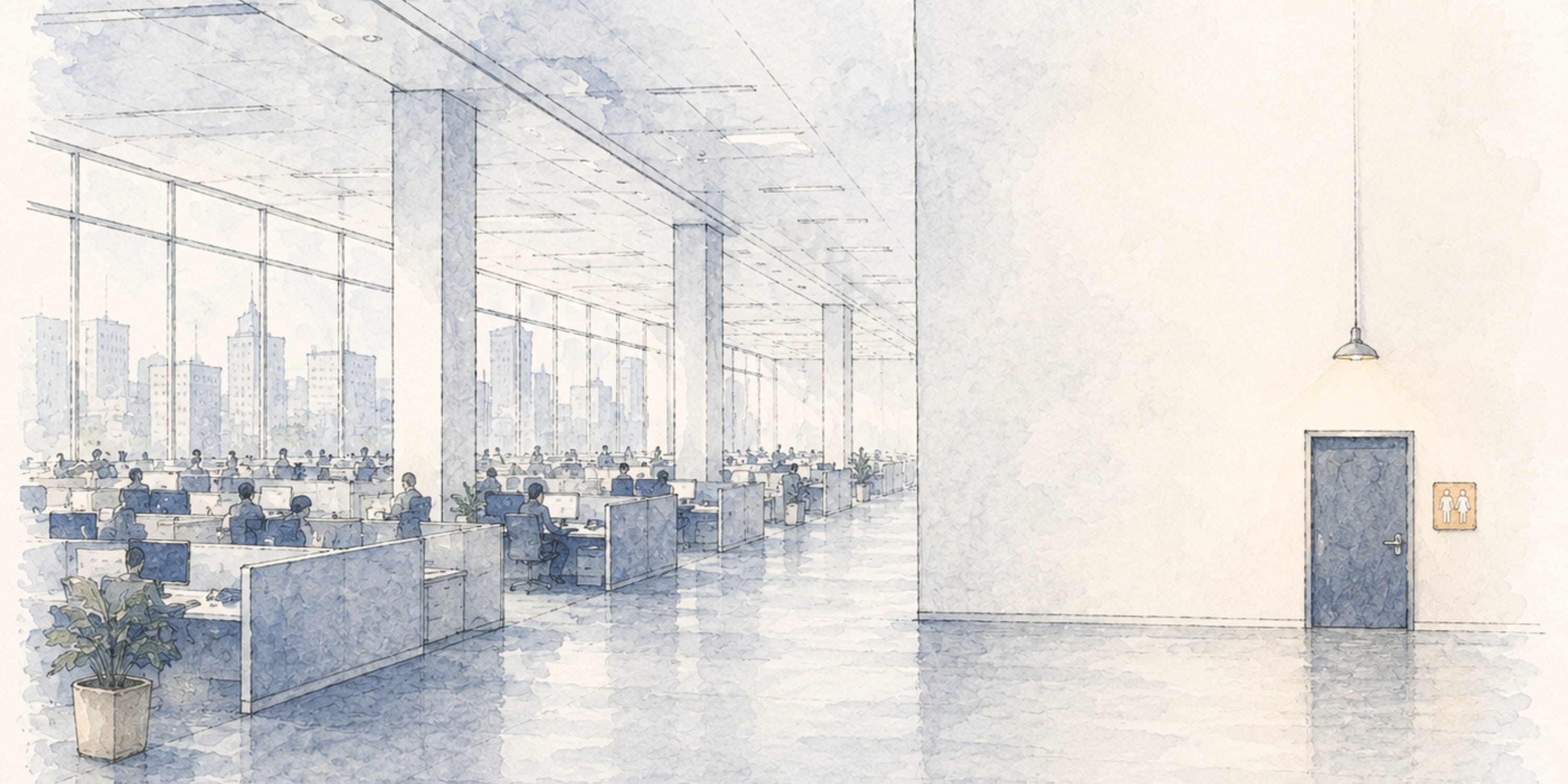
Filed under “Things I Did Not Expect to Find in Professional Workplaces” is the fact that every working environment has an underground bathroom culture. Floor two is the least-used bathroom for when the coffee is too strong. So-and-So only visits this wing when they’re using the secret bathroom that nobody (meaning: everybody) knows about. Here was my pattern: the more I had on my mind or the more stressed I was, the further I would walk to find a restroom so that I could combine the stated task with physical movement, environmental variety, and potential conversations with other colleagues along the way. (Not in the bathroom, of course.) This isn’t a recommendation to simply take longer restroom breaks. It’s to be intentional with physical movement to get steps, engage your lungs, increase your heart rate and blood flow to the brain, and then return to your desk eager to tackle the next item.
It’s not just me. Patricia Albulescu and her colleagues ran a 2022 meta-analysis in PLOS ONE titled “Give me a break!” that pooled twenty-two studies on workplace micro-breaks of roughly ten minutes or less. They found these short breaks consistently increased vigor and reduced fatigue, with no measurable cost to productivity. Driven performers often assume (incorrectly) that breaks are wasted time when they are actually critical mental recovery time that the rest of the day depends on.
With that in mind, how often do you run to the closest water fountain, copy machine, break room, or restroom and miss out on the opportunity for a mental recharge?
Here’s a short list of ways that you can harness inconveniences into strategic mental breaks:
Walk to the furthest bathroom or water fountain in the building, so a basic break becomes a deliberate one.
Park a few blocks away and walk the last stretch to the office so physical movement bookends your day.
Take the stairs anywhere you reasonably can. Race your colleagues using the escalator.
Move random meetings to the patio, the balcony, the rarely-booked conference room, or even to a walking meeting to incorporate variety into busy calendars.
Run one errand on the way home that forces your brain out of work mode before you arrive home.
Have a non-serious podcast queued up for your commute to engage a different part of your brain or imagination.
These are small enough on their own that you can incorporate several into your weekly routines. As I experienced, these micro-choices are physical ways to demonstrate to your mind and your emotions that you still have agency and impact, even if everything around you is hectic. And by choosing to use your agency to improve yourself, you’ll find that your work improves and your presence stays energizing.
Eat Lunch for Strategy
I do not believe in work-life balance, and I have stopped pretending to. Balance implies an equilibrium and suggests that you can achieve it if you are disciplined enough. Based on just about every conversation ever, that is not how real life works. Reinforcing the balance concept pits anything that interrupts that balance as a villain against you, keeping you trapped in a continuous battle, positioned against anything that encroaches.
What I believe in is real-time work-life prioritization. Like breathing, work and life move between inhaling and exhaling: there are seasons where you rest (inhale) and seasons where you exert (exhale). If you think you can do them at the same time, here’s a quick self-assessment for you: inhale deeply, exhale completely, and then try to scream as loud as you can. That’s about how effective you’ll be trying to achieve work-life balance. Rather, knowing which side of the cycle you are on for a given day lets you set honest expectations and choose the right transition for the moment instead of fighting the season you are actually in.
This is why I learned to protect my lunchtime. On days shaped entirely by other people’s meeting invites, lunch is one of the few moments where you can choose intentionality over default. Treat it as a reminder of your own agency, not a luxury you earn after the inbox is clear. Ritualize it regardless of what your coworkers do. Skip lunch too many times and you’ll find yourself operating from a place of depletion and resentment toward the breaks you need but aren’t taking.
If others encroach on your lunchtime, and if the priority truly warrants a lunch meeting, bring your dish to the meeting and demonstrate grounded self-care. A habit I formed after lunch was the small closing act of washing my lunch dish in warm water afterward rather than bringing it home to the dishwasher, because it engaged my hands in a grounding activity and established a physical marker to signify the moment.
The Choice Lives in the In-Between
This is not about making work or life less busy, and it is not about working harder to do more until you burn out. Both of those approaches keep your attention on things you cannot control. The answer to staying sane is to find the places where you still have agency and to use it to amplify what you do.
I once moved from a job with a quick commute to a larger role that required a two and a half block walk between the parking facility and the staff entrance. I expected to resent the parking situation. Instead, it became my favorite forced transition of the day, and I finally had to admit what every fitness coach would have told me: movement is how the brain processes. In a later role without a difficult parking situation, I realized that the small habits mattered even more, which is why I curated the distant water fountain, the unused conference room, the stairs, and the furthest bathroom on purpose.
The simplest practice is also the most overlooked: verbalize each transition moment out loud to yourself. That meeting is over. Now I’m walking to lunch. Inserting a label closes the mental loop for you instead of dragging it into your next obligation.
You will not develop more agency by waiting for your calendar to relent, because it will not. You develop agency in the small moments you choose for yourself in the days you already have.
You are not powerless, but you might be out of practice. The number of things outside your control will not shrink through effort alone. It requires a mindset that knows where your agency still exists and knows how to intentionally transition and disconnect for your wellbeing. You can change whether you walk the long way to the water fountain, guard the thirty minutes at noon, and choose to transition well so that you show up well to the next thing.
* * *
Let’s talk about where your agency has been hiding →
For Further Reading
Žiedelis, A., Urbanavičiūtė, I., & Lazauskaitė-Zabielskė, J. (2022). “Family Boundary Permeability, Difficulties Detaching from Work, and Work-Home Conflict: What Comes First During the Lockdown?” Current Psychology. https://pubmed.ncbi.nlm.nih.gov/35967508/
Albulescu, P., Macsinga, I., Rusu, A., Sulea, C., Bodnaru, A., & Tulbure, B. T. (2022). “’Give Me a Break!’ A Systematic Review and Meta-Analysis on the Efficacy of Micro-Breaks for Increasing Well-Being and Performance.” PLOS ONE, 17(8): e0272460. https://journals.plos.org/plosone/article?id=10.1371/journal.pone.0272460
Aaron Ott is an executive coach who helps leaders promoted for expertise become the leader the role actually requires. He spent 19 years navigating the expert-to-leader transition in the non-profit and for-profit spaces. His coaching practice is built on one belief: you’re capable of so much more than you could ever dream. He lives in Omaha, Nebraska with his wife, Sarah, who is a non-profit operations leader, author, and writing coach. This article is 100% human created, written in the gap between two meetings, on purpose.