

Deeds With the Weeds
What a Childhood Avoidance Habit and My Lawn Taught Me About the Work of Leadership

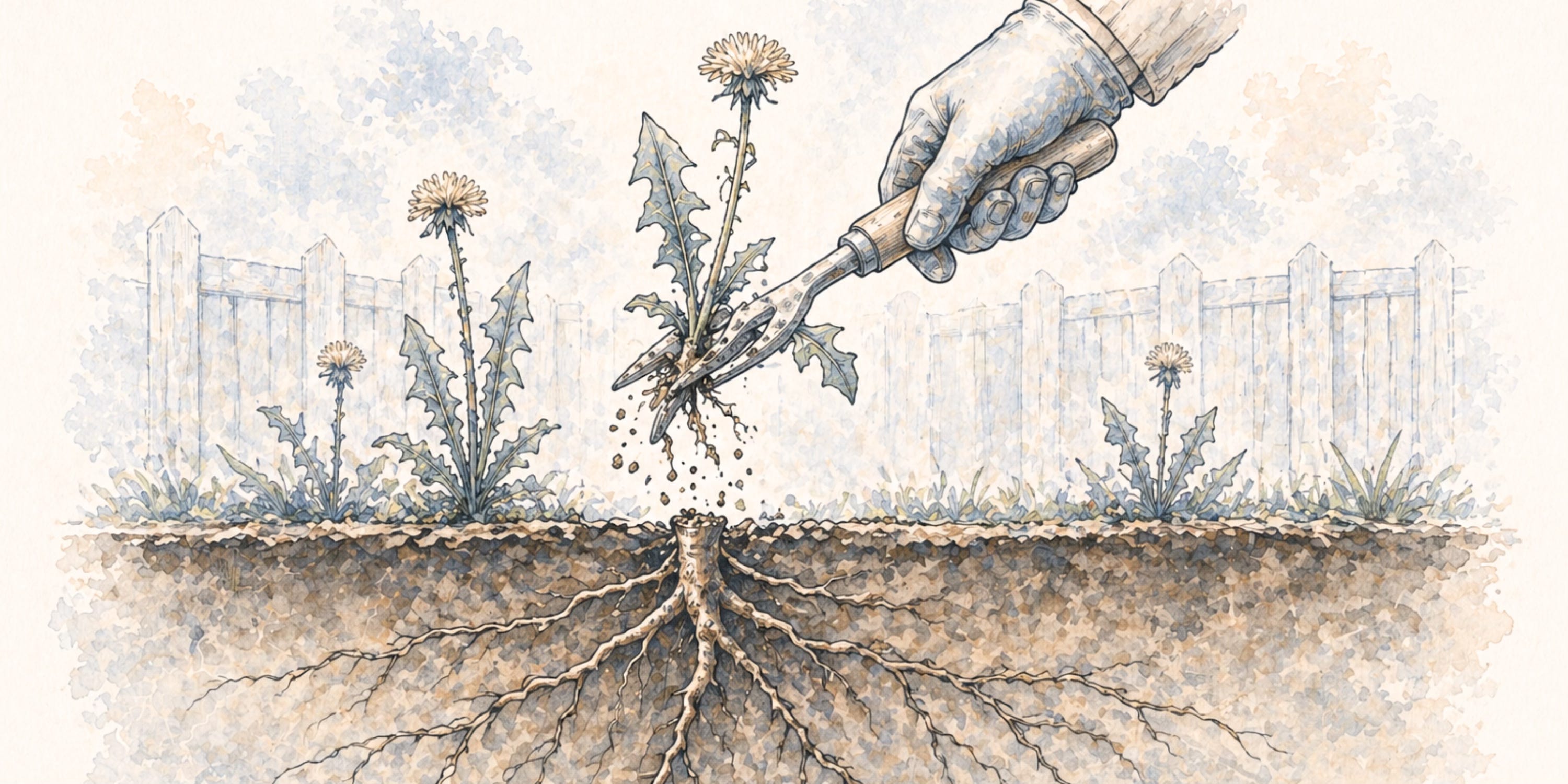
I despised it with the kind of intensity only a twelve-year-old can sustain.
The dread of being asked drove me to keep myself busy with just about anything else to avoid having to do it. I eagerly studied over 1400 pages of the HTML 4.0 developer specification; I practiced Hanon and Czerny piano exercises until I broke a piano string while playing; I produced an album with an early version of Cakewalk Studio on Windows 2000 and my Yamaha PSR 500 keyboard.
I was going all in to avoid weeding the garden.
The excuse was tight. Pulling weeds created risk for my fingers: dirt under my fingernails, smelling like weird plants for days, or the scratch and irritation from prickly invaders (stinging nettles, anyone?). Finger risk was real for a developing musician, and I hid from anything that jeopardized my ability to practice.
Despite the resistance and distraction techniques, I did manage to learn the key tenet of weeding: get the root. If you don’t get the root, it could grow back stronger.
Years later, I purchased a dandelion field, which happened to be my first lawn. Pets and weeds had left the yard in rough shape, demanding heavy work. But I didn’t even want to tackle it until the soil was just right to use a sharp digger to get the whole weed including the root. Those perfect conditions were elusive, so sometimes my wife and I brute-forced weeding sessions; other times we avoided it. Were we successful? Well, we tried, and so did our neighbors’ pappuses.
We finally hired a professional company to begin a yard treatment routine. They couldn’t promise quick results, but we knew that. We did, however, understand that we needed to start a process of continuous improvement sooner, rather than later, to have an enjoyable yard.
A healthy lawn strategy requires a strong foundation and consistent, yet adaptive, techniques. You build a strong foundation by aerating, dethatching, and overseeding to improve the conditions for growth. Then winter dormancy provides a reset window where weeds die. In the spring, a regular cadence of pre-emergents prevents the weeds from even getting started, and strategic fertilizer applications maximize the grass’s potential.
You know what’s easier than weeding an entire yard of dandelions? Removing a small handful of ambitious stragglers that survived the first round of treatments. The next spring, we had significantly fewer weeds to pull, and over the next three to four years, the weeds disappeared altogether.
Finally, a lawn worth a look.
Lawncare in Leadership
Your leadership is like a lawn. You tend to the wellbeing of your identity the same way, and the results of the investment you make in yourself are evident in how you show up for your company, team, family, and community. Well-tended leadership creates space for both you and others to enjoy.
First, if you’re an expert taking on greater leadership responsibility and feeling the tension — both positive and stressful — of new situations, larger teams, or ambitious goals, you don’t have a skill deficiency. But your root system (identity) might still be delivering individual contributions that undermine your leadership potential. Every time you default to an old pattern or behavior, you are letting the weed of individual contribution grow back. The leadership key is: you need to identify the roots in your identity that are actually holding you back.
Then you need to create space for the desirable things to flourish. As you identify where your root tendencies exist, you need to create space and give yourself grace to experiment with new or different leadership approaches. This feels unsettling at first because it demands that you expand beyond your expertise and develop new leadership behaviors. I’ve written that feeling imposter syndrome is a sign that you are growing and moving in the right direction. Feel the stretch, but let something new grow and develop. The leadership key is: you must create intentional space for growth.
Most importantly, you can’t do this alone. My lawn is luscious and green now, but despite the beauty it provides, the grass cannot remove its own weeds. No matter how lush the bluegrass, it does not have the power to overcome intruding roots without outside intervention. Continuous weed abatement is possible because my lawncare company has a large crew with specialized products and equipment, and a consistent cadence to root out the imposters and to strategically apply both inhibitory measures and growth catalysts. The leadership key is: you can’t grow alone.
You don’t just do the work once, either. We moved from that first house into a dream mid-century ranch whose yard was in a similar state as before. This time, we were armed with a strategy, knew when to implement it, and trusted the process to lead to transformation and enjoyment. This year is year four of consistent care, and as you can see below, my lawn outshines the sports field across the street, which looks exactly like my lawn did when we started.


Your Leadership Choice
You may be thriving and enjoying life. I ask you: what might be possible if you took a lawncare look at your leadership? What might you be capable of that you haven’t realized yet? How could you show up for your teams in ways that powerfully develop their potential? Who do you need to become to lead better today? Tomorrow? This quarter? Next quarter? Next year?
I previously wrote about my first foray into coaching, an engagement that came from a place of situational desperation. Since then, I’ve maintained a consistent coaching engagement, continually expanding my leadership alongside it. I’m proud of the work I’ve done and fully accept that the lawn of my leadership requires constant care and tending so that my vision can thrive and my strategy can drive toward success.
Data from management consulting firm FMI found that 87% of respondents reported high return on investment (ROI) from executive coaching, with returns measured at 10 to 49 times the cost of a coach. A 2023 meta-analysis found significant positive effects from executive coaching, including self-efficacy, psychological capital, and resilience. I have experienced a 16.7x ROI on my coaching investments, which drives my passion for seeing other leaders invest in becoming the leader their role requires and increase both their organizational impact and personal satisfaction.
I write about leadership because I believe in creating and contributing to a stronger world. I coach because I’ve been transformed, and because every leader deserves a fierce advocate for their growth and the future they’re capable of building.
So let me ask: Who are you willing to become for what you believe in creating?
You may already find yourself acquiring new skills (AI, anyone?) or bracing for changes to your industry or to organizational structures. Learning new skills is not the same as expanding your identity and leadership for future success. In fact, if you’re learning new skills to avoid looking at the root system like I was doing at age twelve…just book a call. Let’s talk through it.
If this resonates, book a complimentary coaching call →
Aaron Ott is an executive coach who helps leaders promoted for expertise become the leader the role actually requires. He spent 19 years navigating the expert-to-leader transition in the non-profit and for-profit spaces. His coaching practice is built on one belief: you’re capable of so much more than you could ever dream. He lives in Omaha, Nebraska with his wife, Sarah, who is a non-profit operations leader, author, and writing coach. This article is 100% human created. AI-created content variants may help publicize this piece.