

4,000 People Just Lost Their Jobs to AI. The Question Nobody's Asking Is the One That Matters Most.
The leaders who survive it won't be the ones who outwork AI. They'll be the ones who did the identity work before it was forced on them.

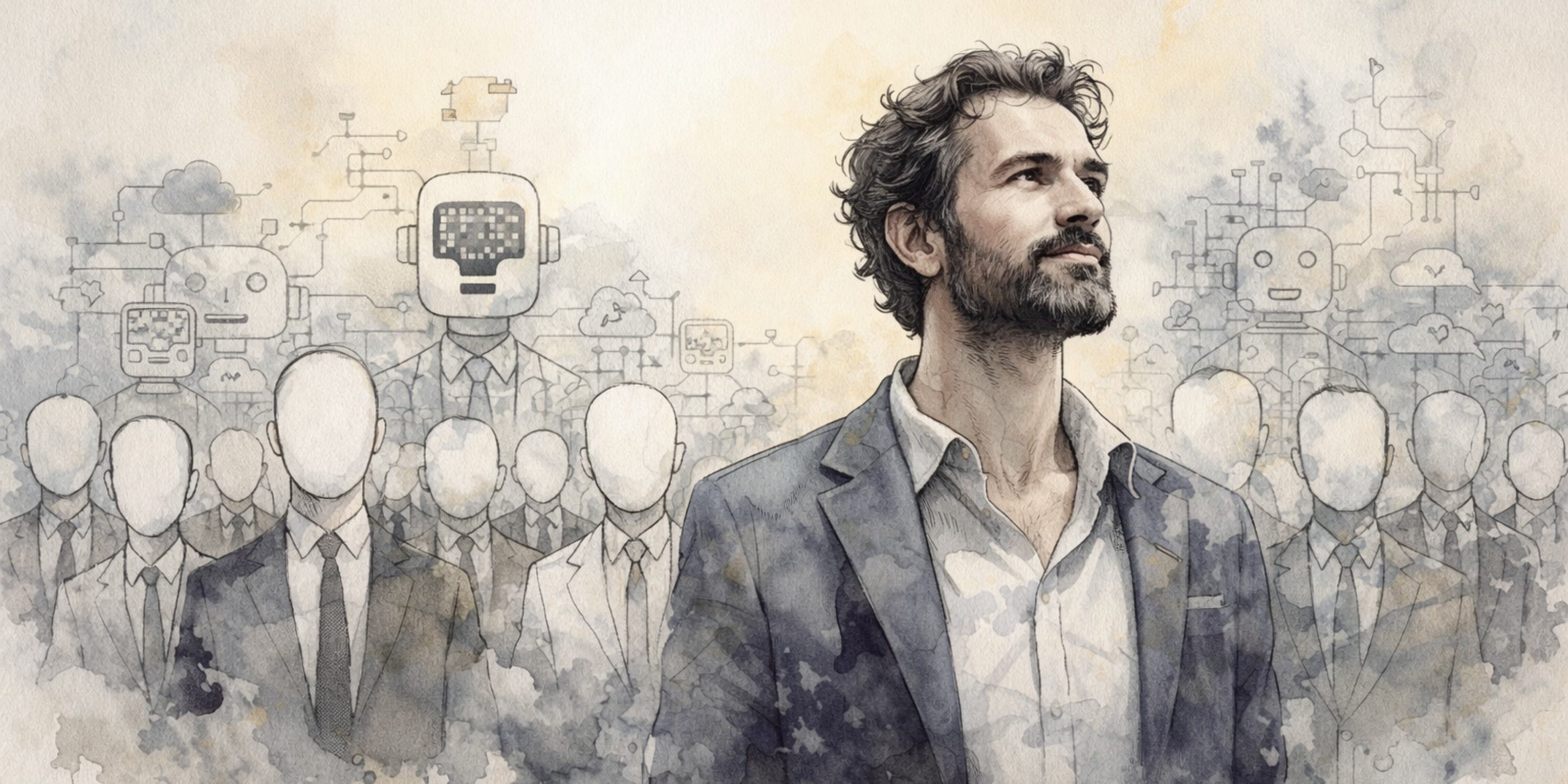
Yesterday, Jack Dorsey posted on X that Block is cutting over 4,000 people. Nearly half the company, gone. (It’s ok if you had to search to see what apps were in Block’s portfolio to realize the scope of the announcement. I did too: they’re the company behind Square, Cash App, Afterpay, Tidal, and more.)
In Dorsey’s own words, the business isn’t failing: the business is strong. Gross profit is growing. Profitability is improving. The reason? AI has changed what it means to build and run a company. A smaller team, paired with intelligence tools, can do more and do it better.
Dorsey then said something that should stop every leader in their tracks: he believes most companies will reach the same conclusion within the next year. He’s not predicting it as a possibility. He’s treating it as an inevitability.
This isn’t a tech story. It’s a human story. The question nobody’s asking in the headlines — the one that will matter most to the 4,000 people clearing out their desks this week and the millions who will follow them — isn’t “how do I stay relevant?”
It’s “Who am I when the thing I’ve always been valued for no longer belongs to me?”
I spent 19 years building a career on expertise, being the person who could see how something should work, reverse-engineer the path, and execute at a level that earned trust and titles. My ability to do and know and deliver was the foundation of my professional identity.
I can tell you with certainty: if I were starting my career today, AI would be able to do most of what made me valuable in year one by the end of the first week.
That’s not a complaint. It’s a fact, and every leader who built their career on technical mastery, domain expertise, or operational execution needs to sit with it, not argue with it.
The world is shifting underneath us whether we acknowledge it or not.
Here’s the shift that I believe is actually happening, and it’s bigger than AI capability and layoffs.
For decades, the professional world has valued humans for three things: what we know, what we produce, and how fast we can do it. Expertise, output, and execution are the currencies that bought careers, promotions, and identities.
AI is systematically devaluing all three.
Now, the tasks that used to require a team of ten can increasingly be handled by two people and a well-orchestrated AI stack. That’s Dorsey’s exact framing, and he’s not wrong. The tools are compounding and it’s shifting the value landscape.
If your value as a leader has been built on being the person who knows the most, produces the best work, or executes the fastest, what happens when a tool can do all of that, cheaper, at scale, and without the additional cost of a human employee?
This is the question that’s keeping leaders awake at 2am, even if they haven’t named it yet. And the real answer isn’t “learn to use AI better than the next person.” That’s a temporary advantage at best. AI literacy is table stakes. It’s the new baseline in the workplace, not the differentiator.
The real differentiator, the thing AI cannot replicate, automate, or replace, is who you are.
The leaders who will thrive in the emerging landscape aren’t the ones who race to learn the newest AI tools. They’re the ones who know who they are without the tools, titles, and output that has always defined them.
Your ability to synthesize lived experience into judgment is something that no model can approximate. Your capacity for relationship, trust, and human presence is what moves people in ways no interface ever will. Your willingness to sit with ambiguity, hold tension, and make meaning out of chaos is uniquely human. Your identity, the grounded, self-aware, fully human version of you that exists apart from any deliverable or job title is at risk of being lost in the AI hustle.
It’s not what you know. It’s not what you produce. It’s who you are. This is where I believe that human value is migrating, and most leaders are completely unprepared for the migration.
This new value landscape will be disorienting for many people. It might even be disorienting for you.
When you’ve spent your entire career being valued for what you produce, and the market suddenly stops rewarding production the same way, you don’t just lose a job function. You lose an identity. And identity loss is not something you can solve with a LinkedIn Learning course or an upskilling bootcamp. You can’t out-learn or out-perform an identity deficiency.
Think about the 4,000 people leaving Block this week. They are talented, accomplished professionals who earned their seats through years of expertise. And the message, even when delivered with severance and grace, is clear: the thing you were hired to do can now be done with fewer people and smarter tools.
That message doesn’t just affect the people who get the email. It radiates. It hits the director who’s been quietly wondering whether her technical depth still matters. The VP who’s been hearing “be more strategic” for two years and is suddenly terrified that strategic might mean “useful for six more months.” The manager who’s been the team’s best individual contributor and just realized that contribution is becoming commodity.
Each of those people is about to face the same reckoning: If I’m not the expert, who am I? If I’m not the one doing the work, what’s my value? If AI can produce what I produce, but faster, better, at scale, then why am I here?
Those aren’t career questions. They’re identity questions that are coming for everyone, whether the layoff hits your company this quarter or next year.
You have two options, and the window between them is closing faster than most people want to admit.
Option one: wait. You can keep doing what you’ve been doing. Keep building your value on output and expertise. Hope that the AI wave takes longer than predicted, or that your specific skill set is harder to automate than you think, or that you can catch the AI wave yourself. And when the shift does arrive, when the restructuring hits your team, or when the role you’ve held for years gets folded into a smaller, flatter org, you can scramble to reinvent yourself in crisis mode.
Option two: start the deep work now.
Ask the questions that matter before they;re forced on you:
Who am I apart from what I produce?
What is my actual value as a human leader; not my technical value, not my output value, but my human value?
What hidden drivers have been running my identity, and what happens when the external rewards they’ve been chasing start to disappear?
This isn’t soft work. This is the most strategic thing you can do right now.
The leaders who will retain their agency through this wave of change aren’t the ones who learn to prompt better than their peers. They’re the ones who’ve done the internal work to know who they are without the title, output, and the approval of an organization that might restructure them out of existence next quarter.
They’re the leaders who have separated their identity from their expertise. Who have learned to lead from who they are, not what they know, and who have built a foundation of self-awareness deep enough that when the ground shifts, they don’t collapse. They iterate and adapt.
Dorsey may be right that change is coming for most companies, and it’s coming faster than most of us have been telling ourselves.
But here’s what Dorsey didn’t say:
The human crisis underneath the economic one is going to be enormous. Millions of accomplished, capable professionals are about to face an identity reckoning they never anticipated. Not because they failed, but because the game changed. Nobody prepared them for a world where their deepest professional skill is no longer their most valuable asset.
If you’re a leader reading this and feel a knot in your stomach, good. That knot is a glimmer of hope that your identity is waiting for you to recognize it. It’s the signal that you’re awake to something most people are still ignoring.
Don’t ignore it.
The AI shift is not primarily a technology problem. It’s an identity problem. The leaders who do the deep, uncomfortable work of understanding who they are beyond their output will be the ones who navigate it with clarity, agency, and something that no algorithm can generate: a grounded sense of self.
You’re in the biggest transition of your career, whether you acknowledge it or not. The best time to start the deep work was last year. The second-best time is right now.
Let’s talk about what’s next for you →
Aaron Ott is an executive coach who helps leaders promoted for expertise navigate the identity shift that comes when expertise alone is no longer enough. After 19 years as an IT leader, he knows what it feels like when the ground moves underneath you, and he helps other leaders find their footing before the next wave hits.